Summer Gathering Announcement – Rideshare Board, Accessibility, What to Bring!

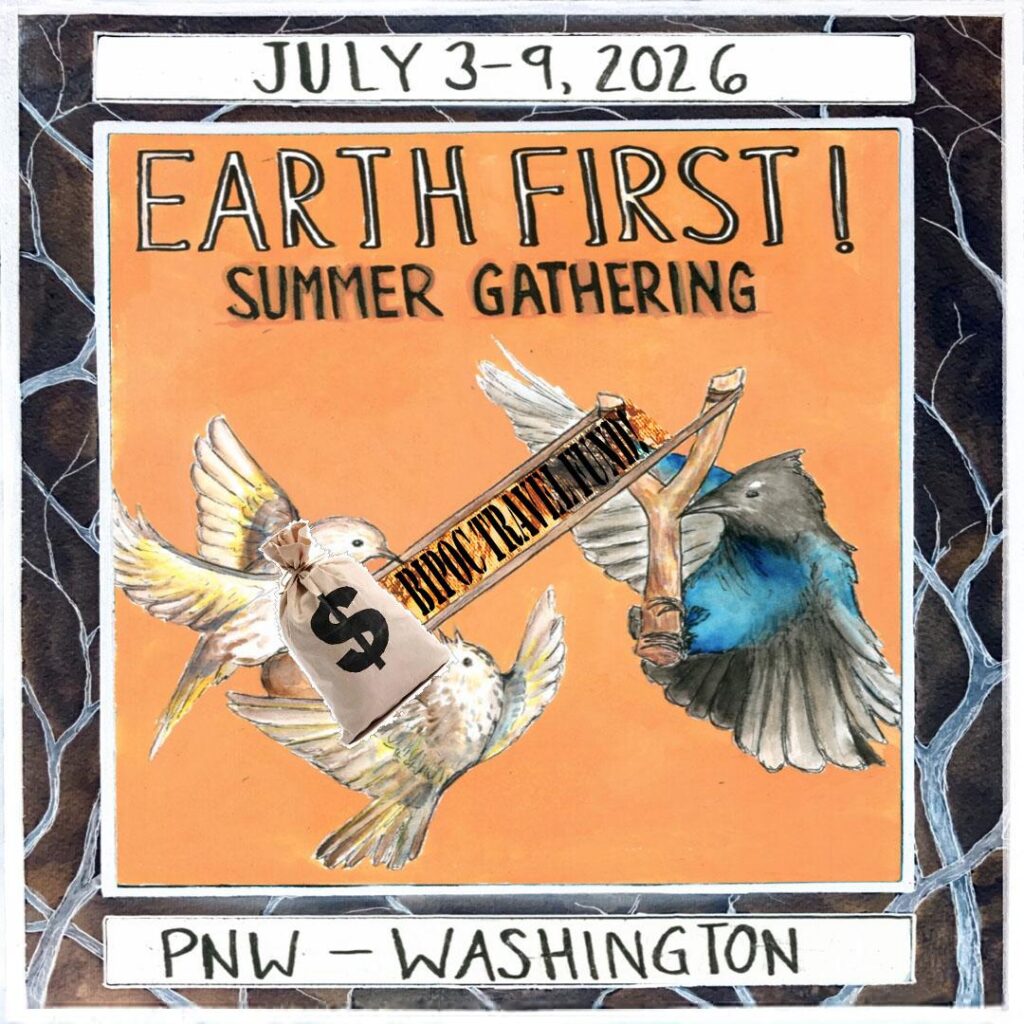
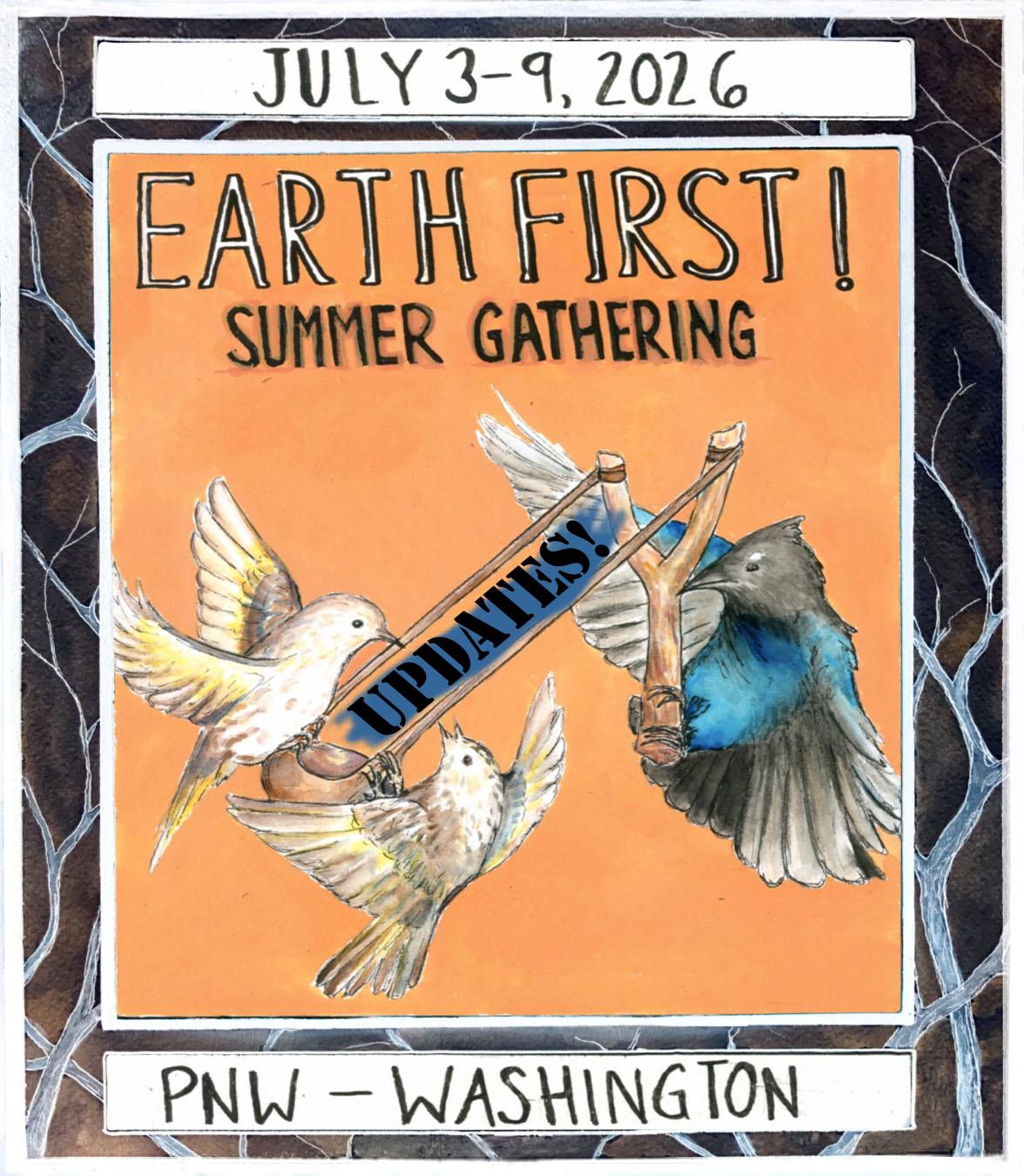
Earth First! Summer Gathering July 3-9, 2026
Updates!
PNW - Washington

We are a month out from the Earth First! Summer Gathering and we are excited to see you in the forest.

This years’ location will be in the woods near to Chehalis Washington. It is equidistant (about 2 hours) from Seattle and Portland. We will be doing the big reveal of address and exact location on June 17th!

For now we want you to have this rideshare board to start planning your carpools:

https://www.groupcarpool.com/t/qn9a45

Please bring camping gear to sleep comfortably outside, clothes for hot and cold weather (it can get cold at night), and a raincoat/poncho in case it rains. Food will be cooked and served at the gathering, but we always need and appreciate donations and food stamps. Bring a water bottle, snacks and anything else you need to be fed, warm, hydrated and comfortable for a week outside in the woods. Please don’t bring your dog! If you must bring your dog, we ask that you keep them leashed.


Accessibility Description

If you have any accessibility questions or to discuss possible accommodations, please email: HotEFSummerPNW@protonmail.me ahead of the gathering. Important locations will be marked via signage and we will have a map with descriptions and terrain as well. The main event spaces (parking, camping field, fire ring, kitchen) are all on flat, or mostly flat land, and consist of mowed grass with some mole hills, uneven bumps, and the occasional stump. Accessibility will have its own camping area close to key resources such as the kitchen and the medic tent. Accessible camping will be within at most about 500ft away with no elevation change from the Morning Circle Space over dirt roads with grass. Accessible Camping is about 600ft with 7ft of elevation change from the programming spaces, going over flat dirt roads at first, then about 100ft of narrower (3 -5ft wide) wood chip path with some tree roots. There will be two wheelchair accessible port-o-potties available in the main area near Accessible Camping. In case of emergency, we do have contingency plans in place if needed, which offer additional support to those in Accessible Camping.

People will be able to drive up directly to the Accessible Camping to drop off stuff and/or people with access needs before parking in the parking area. The parking are is about 1/3 mile from morning circle with 30ft of elevation gain (mostly gradual with one steeper hill) primarily along gravel and dirt roads. There is very limited car camping available in the Accessibility Camping area. If car camping or car access makes the gathering accessible to you, please use it. If not, please leave the space for others.

People are able to cool down in the creek. The shaded forest path also offers a cooler space in its shade. The forest area is mostly flat with a steep slope to the north and small slope to a creek. The forest paths are exposed dirt with small plants and in some areas have roots exposed, mole hills, bumps, and branches. Some workshop spaces are down this path. The ground from the forest to stage areas is mix of bark chips and dirt. There are no indoor or sheltered spaces available on site.

There will be an onsite accessibility coordinator and volunteers available to help with emergent access needs. We will have a limited supply of extra

Camp norms and schedule will come out later this month so keep an eye out on instagram (@earthfirstjournal) as well as https://www.earthfirst.news/

Look forward to seeing you in a month!

Posted in Calls to Action, Events | Tagged , | Comments Off on Summer Gathering Announcement – Rideshare Board, Accessibility, What to Bring!

benefit show in oly for local forest defense & the EF! summer gathering

benefit show in oly for local forest defense & the EF! summer gathering
sat june 6th, doors @ 7:30
live music, hot food, cool vendors, tree nets, and more!

Featuring:

The Flying Leaves

Three for Silver

The Purple Shadows
dm @mantishouse on Instagram for address
$15-$20 suggested donation, NOTAFLOF

Vast marine conservation reserve, bigger than P.E.I., to protect B.C. central coast

by Marissa Birnie The Canadian Press

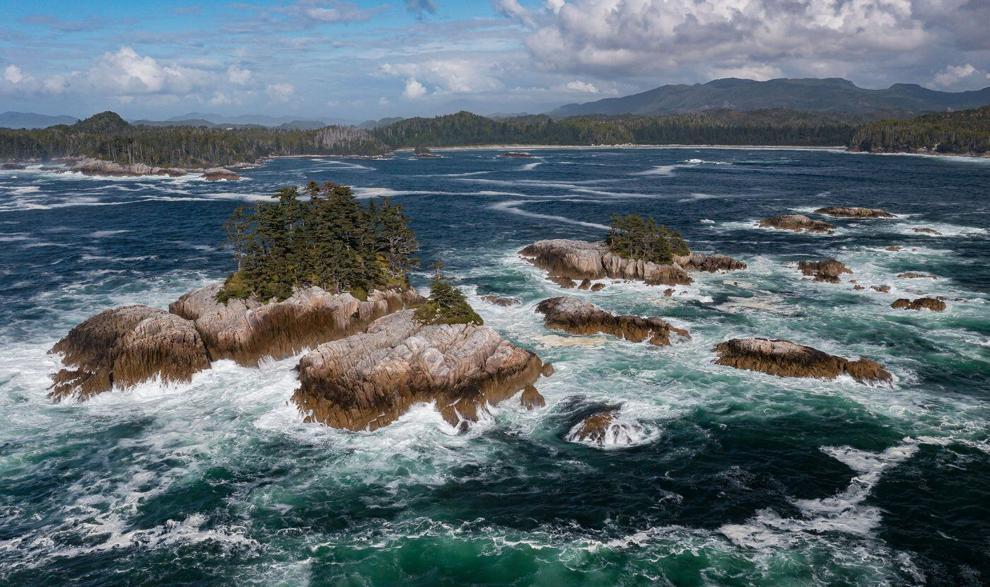
The Mia-yaltwa Halidzogm hoon national marine conservation area reserve on B.C.’s central coast pictured in this undated photo. It spans from Gil Island in the north to just south of Calvert Island, in the south. THE CANADIAN PRESS/Handout — Markus Thompson Thalassia (Mandatory Credit)

An enormous national marine conservation reserve is being established on British Columbia’s central coast, spanning an area larger than Prince Edward Island. 

The protected area, named Mia-yaltwa Ha’lidzogm hoon, is the result of an agreement between six coastal First Nations and the provincial and federal governments. 

An official says the area is around 6700 sq. km and will be operated by Parks Canada along with its Indigenous and federal partners. 

The reserve is within the Great Bear Sea, a diverse marine ecosystem that covers more than half of B.C.’s coast and includes glass sponge reefs, salmon, killer whales and migrating humpbacks.

Though its boundaries aren’t finalized, a Parks Canada representative said the marine reserve spans from near Gil Island in the north, to Calvert Island in the south, extending inland as far as Bella Coola. 

The six Indigenous partners — the Wuikinuxv, Nuxalk, Kitasoo Xai’xais, Heiltsuk, Gitxaała and Gitga’at Nations — declared the area an Indigenous Protected and Conserved Area, which affords them a key role in stewarding conservation efforts through Indigenous governance. 

The area’s name means “realm of the salmon, home of the salmon.” 

Natalie Ban, a professor of environmental studies at the University of Victoria whose expertise includes marine protected areas, said the agreement is great news for the ocean and marine life within it. 

She said the massive area includes deep coastal fiords, dense kelp beds, rocky reefs and mysterious deepsea habitats. 

Juvenile salmon hatch in the region’s estuaries, herring spawn in its streams and fin whales and sea lions scour for the fish along the coast. 

“There’s some really rich diversity of species that are super important,” Ban said.

The federal government says marine conservation reserves are distinct because they fall within areas that are subject to Indigenous land claims, and their status could change depending on the outcome of those claims. 

Its establishment will become official under the Canada National Marine Conservation Areas Act, a process that is expected to take several years. 

“Establishing this protected area will help marine ecosystems, biodiversity, and culturally important values to flourish,” says a news release issued Friday from Parks Canada, the Fisheries Department and the First Nations partners. 

“It will also support Indigenous and coastal communities, as well as the many marine sectors, including fisheries, that depend on a healthy ocean.” 

The Fisheries Department will continue to manage and enforce regulations in the area. 

The next step of the agreement is the creation of a collective management board and a zoning plan that sets out what activities are allowed to occur in the area, with the intent of allowing fishing and tourism to continue. 

A federal official said all fisheries with the exception of bottom trawling may continue in the area. 

Ban said the collaborators must balance protecting marine ecosystems with those who depend on fishing and ocean tourism for their livelihoods. 

The agreement signals a recognition of Indigenous authority in governing the lands and waters of their traditional territories, she said. 

The six First Nations each pointed to their histories of marine stewardship and the importance of that responsibility within their communities. 

“For many years, we have watched our oolichan disappear and our salmon stocks diminish. It is our responsibility to care for this land, as it cares for us, and to support it in a way that enables it to flourish and thrive,” Chief Marlou Shaw of Wuikinuxv Nation said in Friday’s news release. 

The conservation area becomes the sixth of its kind in Canada and the second in B.C. after the Gwaii Haanas National Park Reserve, which covers around 1,500 sq. km of land. 

Ban pointed to Gwaii Haanas as an example of what success could look like for Mia-yaltwa Ha’lidzogm hoon. 

“That has protected those ecosystems and created quite a sustainable ecotourism industry and made it an internationally known destination for people wanting to see this special place,” she said. 

Federal Environment Minister Julie Dabrusin said in the release that the conservation area is part of the government’s goal to conserve 30 per cent of Canada’s marine and coastal waters by 2030. 

This report by The Canadian Press was first published May 22, 2026. 

Mining company pulls out of controversial Pe’ Sla drilling project

by Amanda Schafer with Indian Country Today

Pete Lien & Sons has formally requested its permit to drill near a sacred site in the Black Hills be withdrawn following a weeklong Indigenous occupation at the site.

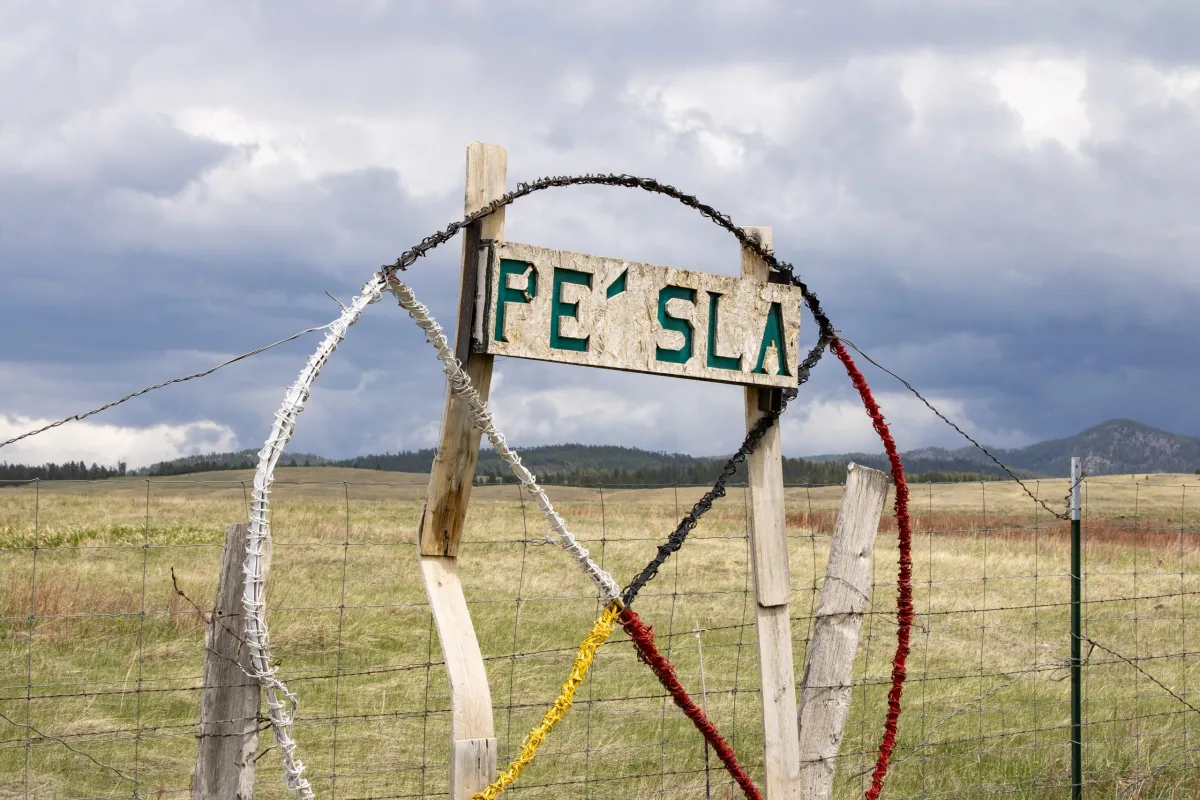
Pe’ Sla is a sacred site for the Oceti Sakowin located in the heart of the Black Hills in western South Dakota. Credit: (Photo by Amelia Schafer, ICT)

RAPID CITY, S.D. – Natural resource mining company Pete Lien & Sons has canceled its plans to conduct exploratory graphite drilling 0.6 miles north of Pe’ Sla, a sacred site within the Black Hills of South Dakota, according to two organizations opposed to the project.

The company sent a letter to the U.S. Forest Service on Friday morning withdrawing the permit that the agency granted on Feb. 27 for 18 graphite drilling sites within the two-mile buffer zone around Pe’ Sla, said NDN Collective and the Black Hills Clean Water Alliance. The buffer zone was created in 2016 by a memorandum of understanding between the Forest Service and several tribes. 

Pe’ Sla is a sacred site to the Oceti Sakowin (Lakota, Dakota and Nakota) tribes and part of the Lakota people’s creation story.

ICT reached out to Pete Lien & Sons and the U.S. Forest Service for comment but hadn’t heard back from either by the time of publication.

The decision comes after a weeklong occupation of the project site by Indigenous treaty defenders, including Lakota youth who “locked down” or tied themselves to the drilling equipment. Four days prior, a temporary restraining order issued by a U.S. judge prohibited all drilling at the site until further court proceedings.

“Today’s successful protection of Pe’ Sla, which is the result of courageous land defense by the community, strategic legal action, and collective prayer, marks a great victory for the people and Mother Earth,” said Wizipan Garriott, president of NDN Collective and Sicangu Lakota, in a statement Friday.

NDN Collective, which helped organize the occupation, said on May 5 that Pete Lien & Sons removed all drills and equipment from the Rochford Mineral Exploratory Drilling Project areas. 

“The Pe’ Sla Protectors Camp successfully accomplished their goal of evicting the drills from the area,” NDN Collective said Friday. “We made the decision to demobilize camp and then developed plans with partners to continue monitoring the site until the injunction hearing later this month to ensure that the drills do not return.”

All drilling at the site was ordered to stop following U.S. District Judge Camela C. Theeler’s ruling on the matter on Monday. Theeler ruled in favor of the two lawsuits against the drilling project, one by nine Oceti Sakowin tribes and another by nonprofit organizations NDN Collective, Black Hills Clean Water Alliance and Earthworks. Theeler granted a temporary restraining order on the project, causing all drilling to stop until the cases could be heard before the court. 

NDN Collective said information revealed during the restraining order hearing Monday showed drilling was already completed at 7 of the 18 permitted drill sites prior to the group beginning its occupation of two sites April 30. 

“Given this pace of work by Pete Lien & Sons, we know that they likely would have completed drilling for most if not all their samples before the (temporary restraining order) was even granted, making our action to protect Pe’ Sla even more consequential,” NDN Collective said in a statement.

BENEFIT SHOW FOR Earth First! Summer Gathering 2026 BIPOC Travel Fund in Oakland

raising funds for the EF summer gathering bipoc travel fund

saturday, june 13th 7pm-12am
at Tamarack in Oakland

featuring live acts by
BODYWORKBODYWORK (OAK)
HAVING CHILDREN (OAK)
PRIDE MONTH BARBIE (LA)
IMMINENT BURIAL (OAK)

music, food, vendors, and more!

“This year’s EF! BIPOC Spoke is looking to build our coalition! We have entered into unpredictable times, with political repression no longer acting underneath a facade. We want this to be an opportunity for world building and a practice in self-sufficiency. All forms of struggle ultimately spring from the desecration of the earth and the prevention of oppressed peoples from living with interdependance and dignity with land. We want to include those who work in all modalities with the land, including farmers, spiritualists, herbalists. We ask for cautious trust in the potential of the network as a channel for connection with likeminded people and site for cultural shifts as the collective expands and changes.

If you are interested in coming, we are currently fundraising for BIPOC travel funds to help with travel.“

Help raise funds for BIPOC attendees/presenters at the EF! Summer Gathering!

From: Seattle EF!

In a continuation of a 30+ year tradition, we will be gathering in the old growth conifer forests of the PNW to inspire each other and sharpen the tools that allow us to collectively resist environmental destruction.

As we face down worsening ecological collapse, authoritarianism, surveillance and repression, we invite everyone who loves the wild to gather, connect, learn and discuss what is to be done. This will be a week of workshops, conversations and revelry that will hopefully bring you closer to the people and skills needed to fight empire and ecocide in your home.

This fundraiser is intended to support the travel needs of BIPOC attendees/presenters who wish to have agency within the gathering but otherwise would not without this support.

Gatherings run on shoe string budgets and food stamps, which are facing significant cuts. Please support EF! and the direct action community. CEOs and earth destroyers don’t want you to do that.

Ensuring that BIPOC frontline community can deepen personal ties within a vastly wide network of environmental activists means we are weaving the web that is holding us together despite and in defiance of the ongoing desecration of our sacred earth.

Funds raised here will primarily go toward those ends. If enough is raised, any extra will help with the logistical needs of putting on the gathering.

Donate Here!

For BIPOC people to access funds go Here!

Among Flowering Plants, Thousands of Evolutionary Oddities at Risk of Extinction

from Yale Environment 360

A new study identifies thousands of flowering plants belonging to rare and ancient lineages that are in urgent need of protection. 

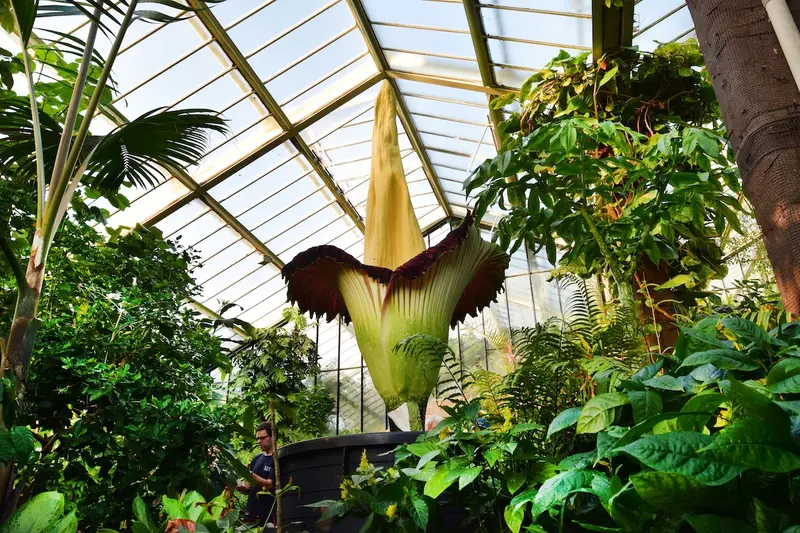
Titan arum, the corpse flower, a distinctive plant at risk of extinction.

These research focuses on species with few surviving relatives, such as the ginkgo tree, which is believed to be the last remaining member of a line that goes back more than 300 million years. The ginkgo occupies a long and isolated branch of the tree of life. If it were to go extinct, scientists say, a significant part of evolutionary history would be lost. 

For the research, scientists evaluated each species of flowering plant — of which there are more than 330,000 — to determine its distinctiveness and its risk of extinction. For plants that had not been formally assessed, they used computer modeling to determine its level of vulnerability.

From this, scientists determined that more than 20 percent of the evolutionary history of flowering plants is at risk of being eradicated. The research, published in the journal Science, identified nearly 10,000 species that should be prioritized for conservation given their unique and threatened evolutionary history. 

Species most in need of conservation include the infamously smelly “corpse flower” of Sumatra, the “jellyfish tree” of the Seychelles, and the “salad plant” of Saint Helena, a tiny island in the South Atlantic. 

Scientists note that many rare and threatened species may ultimately prove highly useful to humans. “When we talk about [distinctive] species as ‘weird and wonderful’ we tend to think of their physical characteristics, whether that’s their bizarre, jellyfish-shaped flowers, or their sheer size, but it also includes the things we can’t see — their molecules, chemicals, and other properties that we as humans depend on,” said coauthor Matilda Brown, a researcher at Royal Botanic Gardens, Kew. 

She said that “losing a deep branch of the tree of life means the potential loss of the next breakthrough cancer drug or antibiotic, with no second chance.”

Trump Administration Lifts Ban on ‘Cyanide Bombs’ on Public Lands

from: New York Times

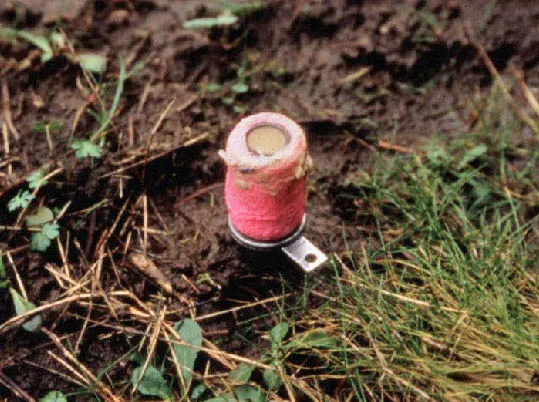
A cyanide bomb. Photo Credit: Brooks Fahy, from publicdomain.media/p/trump-blm-cyanide-bombs-wildlife-services

The Trump administration is lifting a ban on the use of “cyanide bombs” on public lands, reversing course over the objections of environmentalists and animal-rights activists.

The Bureau of Land Management will once again allow the use of the devices, which are spring-loaded traps intended to kill coyotes, foxes and other animals that prey on livestock, according to an internal April memorandum reviewed by The New York Times.

The Biden administration had banned the devices in 2023, saying they were too dangerous to people and wildlife. Public Domain, a Substack newsletter focused on public lands, first reported on the internal April memo.

Cyanide bombs, also known as M-44 devices, spray a lethal dose of sodium cyanide, a highly toxic pesticide, when triggered by a biting animal. They are meant to kill predators that threaten cattle, sheep, goats and other livestock on farms and ranches across the West.

But the devices can also kill or injure people, pets and endangered species. In one 2017 incident that gained national notoriety, the 14-year-old Canyon Mansfield and his dog were sprayed by a cyanide bomb near their Idaho home. The dog, Kasey, collapsed and died. Canyon was rushed to a hospital, where he was treated for temporary blindness.

Alyse Sharpe, a spokeswoman for the Interior Department, which includes the Bureau of Land Management, said in an email that the memo classified M-44s “as tools that may be considered under existing law and environmental review.”

The memo “does not itself authorize or expand use of M‑44s,” she added. “B.L.M. will continue to evaluate proposals case‑by‑case and may prohibit or restrict such tools where warranted to protect public safety, pets, wildlife and designated lands.”

The B.L.M. oversees roughly 245 million acres of public lands. Environmentalists and animal-rights activists sharply criticized the move.

“This dangerous reversal will result in so many indiscriminate killings of pets, endangered wildlife and even people,” said Collette Adkins, who leads the carnivore conservation program at the Center for Biological Diversity, an environmental group.

Wildlife Services, a division of the U.S. Department of Agriculture, has relied on cyanide bombs for farming since the mid-1970s. So have state counterpart agencies in Montana, New Mexico, South Dakota, Texas and Wyoming.

The devices are smeared with scented bait that causes predators to bite them. A capsule containing sodium cyanide is then ejected into the predator’s mouth, killing it within one to five minutes.

In 2019, during President Trump’s first term, the Environmental Protection Agency re-evaluated the use of sodium cyanide in M-44s. The agency ultimately reauthorized its use while instituting new requirements that it said would better protect the public.

Under these requirements, cyanide bombs must be placed more than 600 feet from homes and more than 300 feet from public roads. And they must be accompanied by warning signs in English and Spanish.

In 2023, under the Biden administration, the B.L.M. prohibited Wildlife Services from deploying M-44s on public lands at all, saying it remained concerned about their safety. Nada Wolff Culver, who served as a senior B.L.M. official at the time, said it was disappointing to see the Trump administration change course.

“There is no hiding the risk they are putting on the users of public lands,” she said.

Despite the reversal at the federal level, several states have banned or limited the use of cyanide bombs, including California, Idaho, Oregon and Washington. But the devices are still used to kill thousands of predators each year.

For instance, cyanide bombs killed more than 4,400 coyotes in 2024, the latest year for which data is available, according to Wildlife Services.

USGS Finds 328 Years of Lithium Imports Buried in Appalachia

by Zero Hedge

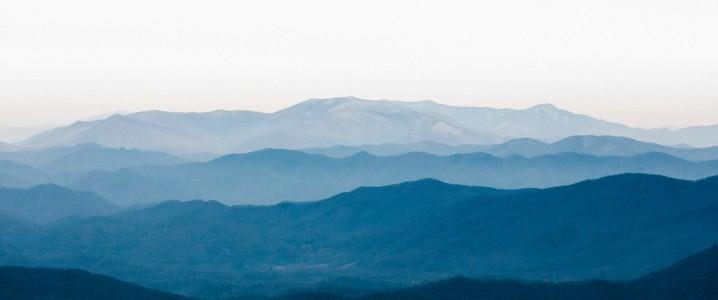
The Great Smoky Mountains National Park, United States

America’s worrisome dependency on foreign sources of lithium could become a thing of the past: About 328 years’ worth of last year’s lithium imports is buried in Appalachia, according to a new analysis published by the US Geological Survey (USGS). That’s about 2.3 million metric tons of undiscovered but economically recoverable lithium — aka “white gold.”

“This research shows that the Appalachians contain enough lithium to help meet the nation’s growing needs – a major contribution to U.S. mineral security, at a time when global lithium demand is rising rapidly,” said USGS Director Ned Mamula. “The United States was the dominant world producer of lithium three decades ago, and this research highlights the abundant potential to reclaim our mineral independence.” Today, Australia is the top producer, and China in second place — however, China boasts about 60% of the world’s lithium refining capacity for batteries.

The deposits are spread over a large swath of territory. The southern Appalachians — primarily the Carolinas — have about 1.43 million metric tons, while the northern Appalachians hold 900,000 metric tons, most of it in Maine, New Hampshire and Vermont, USGS says. Added up, it’s enough to put the requisite lithium in 130 million electric vehicles, or a thousand years worth of laptop production.

USGS project global lithium production capacity will double over the next three years. In April, Finland became the first European country to host the full continuum of lithium production, from an open-pit mine that produces battery-grade lithium hydroxide, to a refinery. “The €783 million project is operated by Keliber Oy, a Finnish mining and battery-materials company,” EuroNews reported.

Today, there’s only one operating lithium mine in America: the Albemarle Silver Peak Mine in Nevada. Earlier this week, environmentalists sued to stop exploratory drilling in Oregon near the Nevada border. The US Bureau of Land Management had given the green light for HiTech Minerals to set up 168 drill sites over five years, on a 7,200-acre expanse of public land. The plaintiffs include “Great Old Broads for Wilderness.” In a 2024 analysis, USGS concluded that brines in southwest Arkansas’ Smackover Formation hold 5 to 19 million metric tons of lithium, but didn’t determine what proportion is economically recoverable.

To say the more-promising Appalachian deposits were created a long time ago is an understatement. “Lithium-rich pegmatites in the northern Appalachians formed from the same geologic forces that built the mountains more than 250 million years ago,” explained the USGS, a Department of the Interior organization and the country’s largest water, earth and biological science mapping organization. “The high heat and pressure during the mountain-building caused some of the deeper crustal rocks to melt, and some of these magmas were rich in lithium.”